

We had nothing to show after five hours of hunting but this, our last location of the day, was a sure spot. The oak forest we were standing in produced year in year out and we were banking on our final call to fulfil an order for that evening. We downed the last of swigs of cold coffee from the flask and let the dogs out of the jeep. All three were extremely keen to get to work, having had very little action all day. They bounded out of the car and dashed straight into the trees, but after an initial enthusiastic burst, they came back to us looking rather deflated. Good truffle dogs become skilled at communicating when there are no truffles in an area- it is part of their job to make the call that we need to move on. The problem was that there was nowhere to move on to.


Now, bad days would not normally be noteworthy, indeed entire dire seasons were nothing new. We had been trying to outrun them for years. Tracking rainfall, researching, plotting routes and moving around had become a big part of truffle hunting. We had set up bases in different areas, even different countries – all to try and beat a lousy season. For a time, that had worked, but now something else seemed to be afoot. Truffles were disappearing from forests that had produced for decades and we were at a point where we needed to start thinking about what would come next.
As to the cause, there were plenty of theories. Recent studies on the impact of climate change made worrying predictions about the end of truffles, pointing the finger at rising temperatures. On the ground there was no denying that the forest floor was definitely drier, summers longer and hotter. But even when the rains came and temperatures were optimum, still there were far fewer, lower quality truffles. Something more seemed to be changing in truffle forests across Europe.


It wasn’t helping that there were more people looking for truffles than ever. These were now concentrated into ever shrinking areas. While you never want hordes of hunters trampling over truffle grounds, the problem wasn’t just in the numbers. A new, very different kind of hunter had appeared- these were a dangerous combination of enthusiasm and inexperience. Over the last five years they had been wreaking havoc on struggling truffle ecosystems that they had no understanding of.
But even the rise of the vandals doesn’t fully explain the changes to the truffle forests. Some of the decline was happening in places that had always been left alone. Quiet woods, carefully worked and known only to a few were also beginning to fail. It seemed that we were losing truffles before we had really got to grips with their role in the forest. We didn’t know what would come next but it wasn’t looking good.
We knew we were in trouble but when we started the plantation it was not part of a grand plan. We weren’t thinking of truffle growing as a way out , we were simply curious to see what would happen if we stuck a couple of dozen hazel saplings in the soil and threw in a handful of spores. Five years on and we had given these young trees little thought and even less aftercare, so it came as a shock when one of the dogs found a truffle growing there. With the unexpected proof of the possibilities staring at us from the soil, we began to take the prospect of actively helping truffles to grow a lot more seriously

This meant planting more trees, many of these were hazels sourced from local forests that also host the truffle Tuber brumale. We knew we didn’t want to create a monoculture but something more akin to the forests we were used to working in, so we began to make room for oak, hornbeam, acacia, pine and fir- tree and plant species that reflect the natural truffle grounds of this region.
Finding those first truffles on our land felt like a gift . We had been trying to study truffles for many years, but in the forest everything is spread out and difficult to follow over time. Wild truffle areas are open to other hunters, to forestry work and to damage that can undo years of growth. Here was the chance to create a haven where we could observe truffles more closely and with fewer hindrances. A place to properly study and better understand how these delicate systems function,.
In a a controlled space like this, we hope to be able to better track what happens from season to season. Shaping the area ourselves gives us greater control over variables like irrigation, shading and the introduction of spores. It will allow experimentation. Above all, it presents us with a unique opportunity to learn.
There’s a great deal still to learn about truffles but one thing we do know about is the importance of spores. Spores are used in the initial stage of the growing process to inoculate the roots of the host tree. As truffle spores germinate, they form microscopic threads that attach to the tree roots. This is the start of the symbiotic partnership in which vital nutrients are exchanged between tree and truffle . Spores also come in handy later on the truffle life cycle . It has been shown that there are two mating types in truffle reproduction – one of the mating types is present on the tree root, the other mating type is found in the soil. Adding spores to the soil surrounding the inoculated trees should therefore aid truffle production.
Given the valuable nature of truffle spores, we make a point of hoarding them. Throughout each season when we are cleaning truffles we save all our cuttings. We also hold on to a few late season, mature specimens as these are particularly spore-rich. Everything is then either dried or put in the freezer to be used after the season is over.
The best time to spread spores is after the rain and when the temperature is not too high. In the past we would simply scatter any truffle scraps around the tree. This changed a few years back when we were given this recipe by an Italian mycologist. It is not complicated and as he seemed to know his stuff, these days we make a slurry out of our truffle pieces. First they get a soaking overnight in a bowl of rainwater along with a tablespoon of fructose. When I am using the mixture to pot a truffle tree or germinate an acorn, I add vermiculite which should help with root formation. I skip that step if I am spreading spores around established trees.
Truffle tree companies often have their own secret truffle production boosting recipes which I am looking forward to trying out in the future. For the moment though, we are sticking to our simple supplement. When it comes to spreading spores, there are various techniques. We have been trying out three and are recording which method is used in which area of our truffle orchard.

The first method is the so-called Spanish wells or truffle traps. The spore mixture is introduced into narrow vertical holes around the tree . This can increase productivity with truffles forming predominantly in the traps. Genetic analysis has shown a direct link to the spores introduced in the traps and the truffles later harvested there. So far, so good. One problem with Spanish wells is this -the truffles tend to concentrate in clusters. It is always exciting to find a whole family of truffles growing together. However in the case of the traps, it means that the fruiting bodies may be discovered at different stages of their development. In other words, you risk unearthing mature and immature truffles at the same time.
The second method mitigates this problem to an extent as, instead of deep holes, we dig a shallow circular trench around the tree. The spores are spread in the upper soil layers, where truffles would naturally form. Spreading spores in this way should encourage a more distributed pattern of growth, closer to what would occur in optimum natural conditions. If this approach succeeds, the result should be less concentrated truffle production. This is easier to work with as you can harvest the ripe truffles without disturbing those destined for later maturation!
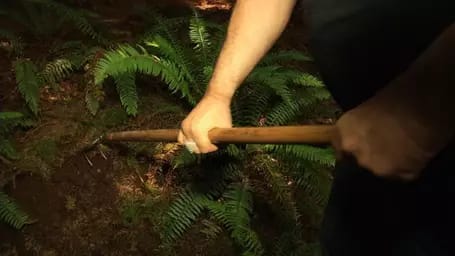
The third way to spread spores uses a rake – apologies, I know that many truffle hunters panic at the mere mention of this tool. In this instance though, the rake is used very lightly to scratch the surface of the ground. This will cause minimal disturbance and as a bonus to truffle production, will gently aerate the earth. With this method, the truffle spores are diffused over a wider area and I suppose that of the three techniques, this one most closely imitates nature. In the forest, truffle spores would be spread in the droppings of small mammals and would end up on the top of the soil so that’s the positioning we are aiming for here.
It will be interesting to see which technique, if any, yields the best results.

Before we head off for the aestivum season next week, I have been spending my mornings in the orchard. It’s early days but poking around here in the soil, I am beginning to get a sense of agency that has been missing these last few years.
While we can, we will still be hunting year round, still chasing kinder weather and better truffle conditions. But now we also have a quieter place to return to – an unremarkable piece of land that we hope will help us find answers to some of the many questions we have about truffles.